Showing posts with label spin. Show all posts

Thursday, 10 March 2011

Spin-doctors, PR and politics

The word 'spin-doctor' seems to have originated in the United States and probably comes from baseball. However, the first definition of 'spin-doctor' as how we know it currently dates back to 1977 and appeared in the Oxford English Dictionary as "a person who provides a favourable slant to an item of news, potentially unpopular policy etcetera, especially on behalf of a political personality or party".

The term 'spin-doctor' started to be used in Britain in the 90s and was associated with the rise of public appearance of Peter Mandelson and other New Labour media experts, with Alastair Campbell as its main figure.  Alastair Campbell was the Director of Communications and Strategy for Tony Blair between 1997 and 2003 and was considered to be one of the greatest 'spin-doctors' in British politics. 


Alastair Campbell
He is said to have manipulated the press during his time working for Downing Street and to have used journalists to communicate the news he wanted to. However, he also revolutionised political communications in the UK. He managed that tabloids supported the Labour Party and also kept lobby journalists informed more than his predecesors; he established two daily briefings, one in the morning and one in the afternoon.

Campbell resigned after the death of civil servant Dr Kelly who appeared death after it was leaked that it was him who talked to the BBC and told them that no weapons of mass destruction were to be found in Iraq and that the government had inserted false intelligence into the dossier presented to defend the reasons for the war. Many believed that it was Campbell who had rewritten the dossier but it was never proved. 


On 1 March the University of Westminster held a debate around the motion: Have PR and spin undermined trust in politics? Kevin Maguire, political journalist of the Daily Mirror, and Sheila Gunn, fomer political journalist and spokesperson for John Mayor, argued that Public Relations and spin had undermined trust in politics and that they had seen it with their own eyes. On the contrary, Francis Ingham, CEO of the PRCA, and Lance Price one of the former 'spin-doctors' on Downing street, claimed that it was not PR practitioners the ones to blame but journalists and even politicians, as Ingham pointed out, the ones responsible for the lack of trust in politics.


After the debate the motion was put to the vote and finally it was agreed that Public Relations had not undermined the trust in politics in the UK with 78 votes.There were 61 people who voted for the motion. Do you agree with the result?

For further information on spin and Alastair Campbell refer to:
- Richards, P., (2005). Be your own spin doctor: a practical guide to using the media. London: Politico's
- Oborne, P. and Walters, S., (2004). Alastair Campbell. London: Aurum Press
http://www.youtube.com/watch?v=X_SP-HMhJtc&feature=related

Saturday, 5 February 2011

When the Truth must be kept secret

These last days on television, newspapers, radio, blogs, twitter, on the street... we continuously hear the news and information about the uprising in Egypt. Thousands, millions of people are taking the streets in the capital city to protest against the repressive regime of Mubarak, who has been oppressing its inhabitans and has been involved in corrupt activities. They demand his immediate resignation, but Mubarak seems not to listen.

We are able to receive all this information because we live in a global world where anyone can get news 24/7, where correspondents are sent to the focus of news, where journalists work all day and expose themselves to danger so that we can be informed about what is going on in the world. And, sometimes, it is not easy for them to do their job.
Protests at Tahrir Square, Cairo

In the Egypt riots these last ten days we hear how difficult it is to inform about a repressive country in hard times. Despite the fact that we are in the 21st century some governments do not care about international law or press freedom when it is about preserving their image. 

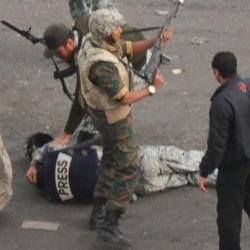
Journalists are informing that Egyptian police, Mubarak's secret police and supporters are attacking them, arresting them, confiscating their equipment and even destroying it. Why do they do that? Well, the answer is very simple. Mubarak's government wants to avoid that journalists tell the truth about the situation in which his country is right now. 

Journalist on the floor being stopped by the army
Media crew from various countries have suffered from the attacks. At first it seemed that just Arabic language news channels (al-Jazeera and al-Arabiya) were the target of pro-government protesters, but in the last few days press crew from Britain, the US, Spain, Greece and France have also been injured. 

As Mubarak cannot control the protests and Egyptians, he at least tries to control the media. His first movement was to cut Internet access in the country so that the population could not inform others via Emails, Facebook or Twitter. His tactic worked for some days but operators quickly found a way to overcome Mubarak's cuts. When the Internet was restablished, the next step was the media, broadcast and print media. 

At this moment nobody with a notepad or camera in hand is safe in Egypt. The government is determined to hide the truth and will do anything to achieve that. However, Mubarak and his supporters are not being successful. This time he will not end up being victorious by playing with the truth. Fortunately, the world seems not to accept anymore war spin and propaganda. 

Below you can watch a video showing the experiences of two journalists attacked in Cairo. 

Saturday, 22 January 2011

War Spin

The first lesson of the module "Contemporary Theory and Issues in Public Relations" was about spinning during war times. 
Terry Lloyd, journalist who reported from Iraq

In times of war, governments want to have public opinion in favour. This is why it is important to show a positive image of their actions. Spin during war times has long been used but the most recent and clear example is the Iraq War. 


During the Iraqi War thousands of journalists travelled to Iraq as embedded journalists to report from the first war line. However, the allies tried to manipulate the journalists from the very beginning by providing them with the information they wanted, by not answering some questions which could put them in a bad position, by keeping hundreds of journalists away from the front line and just receiving information from TV channels, etc. 
José Couso, cameraman who died during the Iraq War

But this is simply propaganda. The sole purpose of this was to keep a good image of the allies throughout the war. They used the media, one of the most trusted channels of information by the public, to place themselves as the “savers” and demonise the Iraqi Government.

The use of PR during war times leads usually to spin, persuasion and propaganda. As future PR practitioners we should think about the boundaries of our job, if we lie or hide the truth to protect our client and if it is ethical to use other professionals to spread what we want to be believed. 

For more information realted to War Spin visit the following links:
- BBC News: 
http://news.bbc.co.uk/1/hi/programmes/correspondent/3028585.stm
- Time: 
http://www.time.com/time/magazine/article/0,9171,1004965-1,00.html
- Blog of a University of Westminster student:
http://contemporarypr.blogspot.com/2010/01/war-spin-pr-and-propaganda.html