Thursday, 10 March 2011

Spin-doctors, PR and politics

The word 'spin-doctor' seems to have originated in the United States and probably comes from baseball. However, the first definition of 'spin-doctor' as how we know it currently dates back to 1977 and appeared in the Oxford English Dictionary as "a person who provides a favourable slant to an item of news, potentially unpopular policy etcetera, especially on behalf of a political personality or party".

The term 'spin-doctor' started to be used in Britain in the 90s and was associated with the rise of public appearance of Peter Mandelson and other New Labour media experts, with Alastair Campbell as its main figure.  Alastair Campbell was the Director of Communications and Strategy for Tony Blair between 1997 and 2003 and was considered to be one of the greatest 'spin-doctors' in British politics. 


Alastair Campbell
He is said to have manipulated the press during his time working for Downing Street and to have used journalists to communicate the news he wanted to. However, he also revolutionised political communications in the UK. He managed that tabloids supported the Labour Party and also kept lobby journalists informed more than his predecesors; he established two daily briefings, one in the morning and one in the afternoon.

Campbell resigned after the death of civil servant Dr Kelly who appeared death after it was leaked that it was him who talked to the BBC and told them that no weapons of mass destruction were to be found in Iraq and that the government had inserted false intelligence into the dossier presented to defend the reasons for the war. Many believed that it was Campbell who had rewritten the dossier but it was never proved. 


On 1 March the University of Westminster held a debate around the motion: Have PR and spin undermined trust in politics? Kevin Maguire, political journalist of the Daily Mirror, and Sheila Gunn, fomer political journalist and spokesperson for John Mayor, argued that Public Relations and spin had undermined trust in politics and that they had seen it with their own eyes. On the contrary, Francis Ingham, CEO of the PRCA, and Lance Price one of the former 'spin-doctors' on Downing street, claimed that it was not PR practitioners the ones to blame but journalists and even politicians, as Ingham pointed out, the ones responsible for the lack of trust in politics.


After the debate the motion was put to the vote and finally it was agreed that Public Relations had not undermined the trust in politics in the UK with 78 votes.There were 61 people who voted for the motion. Do you agree with the result?

For further information on spin and Alastair Campbell refer to:
- Richards, P., (2005). Be your own spin doctor: a practical guide to using the media. London: Politico's
- Oborne, P. and Walters, S., (2004). Alastair Campbell. London: Aurum Press
http://www.youtube.com/watch?v=X_SP-HMhJtc&feature=related

Wednesday, 2 March 2011

The use of social media for PR purposes

These days everybody is talking about social media and its effect on society. It seems that everything we do now is linked to social media and this is, in a way, true. Social media is affecting our daily life and decisions in a manner that has exceeded all predictions. 

Businesses have also become aware of the importance of social media and have now incorporated it to its communication channels and Public Relations plays an important role as far as the use of social media in a company is concerned. 

The use of social media by corporates started mainly with a marketing purpose in mind but now, they have realised that the use of social media with public relations purposes can benefit the company in an incredible way. 

Public Relations has a huge amount of social media tools at its disposal. These tools can be used to build and promote brand reputation, raise awareness, target a wider audience, interact with them and enable a two-way communication, communicate specific messages to desired stakeholders and receive suggestions from them. These are just some examples of the benefits of social media for a corporate communications use.  

With platforms such as Facebook companies can create fan pages with which they can form a community and interact with it. This way they can inform their audiences more directly as well as listen to their personal opinions. The same happens with Twitter, although it offers the advantage that the message is spread quicker to a wider audience. With YouTube, for instance, the CEO can communicate a message to the company's stakeholders or viral videos can be posted with the purpose of raising awareness; and Linkedin, for example, can help companies to find new employees. 

Letting the message outside and allowing interaction also implies the possibility of receiving criticisms. When this happens, it is essential to answer positively and quickly so that these critics do not get viral and start flooding the company's social media sites. For this reason, it is vital that Public Relations constantly monitor what is been said in social media about the organisations they are working for. 

The following webcast goes through these and oher issues concerning social media and its relation to PR. I hope you enjoy it!


This video is part of an assignment and has an educational purpose. Images have been taken from different sources on the Internet.

Thursday, 10 February 2011

NGOs, threat or opportunity?

There is a little bit of controverse when deciding if NGOs and activists represent a threat for corporates or if they can actually be an opportunity for the organisation to show the community that the company also collaborates with good causes.

Corporates sometimes fear NGOs and activist groups because they can affect the company negatively when the cause they defend does not fit with the way the company operates. Then they use tactics such as mass events, stunts, Non-violent Direct Action (NVDA), surveys and reports, controversies via different channels, and rogue websites to attract traditional and online media, stimulate public debate and press the organisation to change their behaviour or activity.

Members of UkUncut at a shop
When these situations happen, the PR department of the company should try to listen to the demands of the NGO and try to reach agreements so that the matter does not go public and affects the company's image and reputation. Some NGOs have an insider approach which tends to be less radical and allows conversations with the company in order to negociate changes which are positive for both parties.

Nonetheless, NGOs can also benefit corporations. With CSR activities, companies collaborate with NGOs or support community causes. This way they are doing something good for the community and at the same time they are reflecting a good image of their company.  As everything in life, NGOs and activist groups have positive as well as negative effects for a business. The challenge is on finding a balance. Companies should engage into conversation with pressure groups and try to arrive to agreements beneficial for the company as well as for the community or the environment. 

Wednesday, 9 February 2011

Stakeholders and PR

Knowing the audience of your organisation is very important as it helps to define the company's strategy. For PR practitioners it is essential to define the company's stakeholders in order to convey the right message.

There is different terminology used in PR books to name those who can affect or be affected by the activity and actions of a business. Different terms are used audience (which seems to have fallen into misuse), stakeholders and publics.

One of the most important theorists in Public Relations, Grunig, defines a stakeholder as someone who has an interest in an organisation. In his opinion publics have a stronger interest in the organisation and are more active than stakeholders. In his situational theory he differenciates between different types of publics. The non-publics are those groups that are not very affected by the company. The latent public is someone who might have an interest in the organisation; then there is the aware public who, appart from having some interest in the company, also know the company. And finally, the active public are those people who can affect the company. Grunig describes the different types of publics in his situational theory, which in contrast with other theories is not static and claims that relationships can change.
Power-interest matrix

Another important stakeholder theory is the power-interest matrix. It does not define stakeholders; they must be defined by the organisation and, because relationships between a company and its stakeholders can also change, they have to be monitored continously. This theory divides groups by power and interest rates and explains how the company should deal with them depending on their power and interest.

There are many theories on stakeholders such as Bernstein's Wheel and Esman's linkages theory. However, Grunig's situational theory and the power-interest matrix theory are the ones that most fit with the current PR practice.

Monday, 7 February 2011

Bad crisis management, a case study

A crisis can arise at any moment and sometimes it can even affect and destroy companies with a very good reputation. This is what happened last year to the biggest automobile producer, Toyota. 

Toyota had a very good reputation in terms of quality and reliability of its cars. Over its seventy years of existence, Toyota had established itself as a leader in the Japanese market and in 2007 it became the world's biggest auto producer. However, in the beginning of 2010 Toyota's leading position started to be in danger. 

Since September 2009 Toyota had been receiving a lot of critics as the causes of some car accidents in the US were pointing to its direction. It seemed that some Toyota models were having acceleration problems. At first the company denied it was their fault and tried to blame customers, but then changed its strategy and informed that it could be a problem with the floor mats of spefic models. They started then a recall of millions of cars. The reason of this recall were floor mats. 

After more rumours and accidents, in January 2010, they were obliged to recall another 2.3 million cars due to problems in the gas pedal. From this moment on Toyota changed its communication strategy as critics began to overwhelm them. The company started informing their customers constantly. Toyota's president, the quality president and the director of Toyota in the US attended press conferences, gave interviews and even appeared before a US committee.
Toyota's president (left) listens to the
House of Representatives' Committee


The consequences of this crisis were devastating for Toyota. They lost millions of dollars, had to pay a fine and its stock market value dicreased in 17% in just a couple of months. But what is worse, their reputation was extremely damaged.


Toyota did not get it right as far as its communication strategy is concerned. They were late in responding complaints, doubts and critics; when they did it they never accepted their culpability (probably because they were recommended to do so by its lawyers) and its leaders waited too long before appearing publicly. The paradox here is that in December 2009 they had appointed a new Head of Communications.


It is very likely that if Toyota had decided to be more transparent from the very beginning and approached its customers faster, the consequences of this crisis would not have been that intense. They owned a good reputation and now it has been damaged because of a bad handling of a crisis. However, now they know what not to do again.


To learn more about the Toyota crisis watch the following video from a presentation I held at my Corporate Communications module.

Saturday, 5 February 2011

Objective: Crisis Avoidance

The word that everyone wants to avoid, be it an organisation, a government or an individual is CRISIS. Everyone, by all means, wants to prevent a crisis to arise. This goes without saying. The question we may ask ourselves is if we can avoid it and if not, what we can do to soften its consequences.

The answer to the first question is complicated as there are times when crisis can be prevented or predicted but, others, when there is nothing we can do to stop them happening. This last case is for example in the event of natural disasters. Under these circumstances, there is nothing one can do to elude the crisis but if we are prepared, we can minimise its effects. For this reason, it is very important to always be prepared to face a crisis, either to prevent it from happening or to attenuate the consequences.

Here is a list with some tips to guarantee a good recovery from a crisis. They are mostly applicable for a company but they can also be extended to any public institution and even an individual.

- Be prepared for the worst. Companies should plan in advance what should be done in times of crisis. They should establish guidelines that can help them operate in bad situations and determine who has to be in charge (preferably a PR professional) and the tasks everyone should carry out. 


- Respond immediately. There is no point in waiting too much to inform the company's stakeholders. This makes the matter grow bigger and can even generate worse consequences, especially if someone else spreads rummors or gives false information about thecompany.


- ALWAYS tell the truth. In times of crisis companies tend to be economical with the truth because they are afraid of more adverse effects if they are transparent. However, telling the truth is the best way to make your customers and other stakeholders trust you. 


- Communicate directly and continuously. These days social media lets companies engage into conversation with its stakeholders, which makes it one of the best channels through which to communicate during a crisis. Not only it reaches many people in a matter of seconds but it also allows a continuous conversation between the company and its stakeholders.


- Build a good reputation. Reputation is essential to diminish the effects of a crisis. It takes years to build it and it can be destroyed immediately. However, if the company owns a good reputation, the company may still be able to cope with the crisis and overcome it. Of course, later on the PR department will have to work on rebuilding the reputation to the state it was before the crisis. 


These are examples of the most important actions to be implemented before, during and after a crisis. The way a crisis should be handled depends on the type of crisis, the company and other factors including the company's environment and its position in the market. 

When the Truth must be kept secret

These last days on television, newspapers, radio, blogs, twitter, on the street... we continuously hear the news and information about the uprising in Egypt. Thousands, millions of people are taking the streets in the capital city to protest against the repressive regime of Mubarak, who has been oppressing its inhabitans and has been involved in corrupt activities. They demand his immediate resignation, but Mubarak seems not to listen.

We are able to receive all this information because we live in a global world where anyone can get news 24/7, where correspondents are sent to the focus of news, where journalists work all day and expose themselves to danger so that we can be informed about what is going on in the world. And, sometimes, it is not easy for them to do their job.
Protests at Tahrir Square, Cairo

In the Egypt riots these last ten days we hear how difficult it is to inform about a repressive country in hard times. Despite the fact that we are in the 21st century some governments do not care about international law or press freedom when it is about preserving their image. 

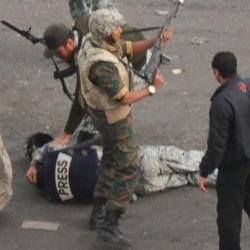
Journalists are informing that Egyptian police, Mubarak's secret police and supporters are attacking them, arresting them, confiscating their equipment and even destroying it. Why do they do that? Well, the answer is very simple. Mubarak's government wants to avoid that journalists tell the truth about the situation in which his country is right now. 

Journalist on the floor being stopped by the army
Media crew from various countries have suffered from the attacks. At first it seemed that just Arabic language news channels (al-Jazeera and al-Arabiya) were the target of pro-government protesters, but in the last few days press crew from Britain, the US, Spain, Greece and France have also been injured. 

As Mubarak cannot control the protests and Egyptians, he at least tries to control the media. His first movement was to cut Internet access in the country so that the population could not inform others via Emails, Facebook or Twitter. His tactic worked for some days but operators quickly found a way to overcome Mubarak's cuts. When the Internet was restablished, the next step was the media, broadcast and print media. 

At this moment nobody with a notepad or camera in hand is safe in Egypt. The government is determined to hide the truth and will do anything to achieve that. However, Mubarak and his supporters are not being successful. This time he will not end up being victorious by playing with the truth. Fortunately, the world seems not to accept anymore war spin and propaganda. 

Below you can watch a video showing the experiences of two journalists attacked in Cairo.