Wednesday, 9 February 2011

Stakeholders and PR

Knowing the audience of your organisation is very important as it helps to define the company's strategy. For PR practitioners it is essential to define the company's stakeholders in order to convey the right message.

There is different terminology used in PR books to name those who can affect or be affected by the activity and actions of a business. Different terms are used audience (which seems to have fallen into misuse), stakeholders and publics.

One of the most important theorists in Public Relations, Grunig, defines a stakeholder as someone who has an interest in an organisation. In his opinion publics have a stronger interest in the organisation and are more active than stakeholders. In his situational theory he differenciates between different types of publics. The non-publics are those groups that are not very affected by the company. The latent public is someone who might have an interest in the organisation; then there is the aware public who, appart from having some interest in the company, also know the company. And finally, the active public are those people who can affect the company. Grunig describes the different types of publics in his situational theory, which in contrast with other theories is not static and claims that relationships can change.
Power-interest matrix

Another important stakeholder theory is the power-interest matrix. It does not define stakeholders; they must be defined by the organisation and, because relationships between a company and its stakeholders can also change, they have to be monitored continously. This theory divides groups by power and interest rates and explains how the company should deal with them depending on their power and interest.

There are many theories on stakeholders such as Bernstein's Wheel and Esman's linkages theory. However, Grunig's situational theory and the power-interest matrix theory are the ones that most fit with the current PR practice.

Monday, 7 February 2011

Bad crisis management, a case study

A crisis can arise at any moment and sometimes it can even affect and destroy companies with a very good reputation. This is what happened last year to the biggest automobile producer, Toyota. 

Toyota had a very good reputation in terms of quality and reliability of its cars. Over its seventy years of existence, Toyota had established itself as a leader in the Japanese market and in 2007 it became the world's biggest auto producer. However, in the beginning of 2010 Toyota's leading position started to be in danger. 

Since September 2009 Toyota had been receiving a lot of critics as the causes of some car accidents in the US were pointing to its direction. It seemed that some Toyota models were having acceleration problems. At first the company denied it was their fault and tried to blame customers, but then changed its strategy and informed that it could be a problem with the floor mats of spefic models. They started then a recall of millions of cars. The reason of this recall were floor mats. 

After more rumours and accidents, in January 2010, they were obliged to recall another 2.3 million cars due to problems in the gas pedal. From this moment on Toyota changed its communication strategy as critics began to overwhelm them. The company started informing their customers constantly. Toyota's president, the quality president and the director of Toyota in the US attended press conferences, gave interviews and even appeared before a US committee.
Toyota's president (left) listens to the
House of Representatives' Committee


The consequences of this crisis were devastating for Toyota. They lost millions of dollars, had to pay a fine and its stock market value dicreased in 17% in just a couple of months. But what is worse, their reputation was extremely damaged.


Toyota did not get it right as far as its communication strategy is concerned. They were late in responding complaints, doubts and critics; when they did it they never accepted their culpability (probably because they were recommended to do so by its lawyers) and its leaders waited too long before appearing publicly. The paradox here is that in December 2009 they had appointed a new Head of Communications.


It is very likely that if Toyota had decided to be more transparent from the very beginning and approached its customers faster, the consequences of this crisis would not have been that intense. They owned a good reputation and now it has been damaged because of a bad handling of a crisis. However, now they know what not to do again.


To learn more about the Toyota crisis watch the following video from a presentation I held at my Corporate Communications module.

Saturday, 5 February 2011

Objective: Crisis Avoidance

The word that everyone wants to avoid, be it an organisation, a government or an individual is CRISIS. Everyone, by all means, wants to prevent a crisis to arise. This goes without saying. The question we may ask ourselves is if we can avoid it and if not, what we can do to soften its consequences.

The answer to the first question is complicated as there are times when crisis can be prevented or predicted but, others, when there is nothing we can do to stop them happening. This last case is for example in the event of natural disasters. Under these circumstances, there is nothing one can do to elude the crisis but if we are prepared, we can minimise its effects. For this reason, it is very important to always be prepared to face a crisis, either to prevent it from happening or to attenuate the consequences.

Here is a list with some tips to guarantee a good recovery from a crisis. They are mostly applicable for a company but they can also be extended to any public institution and even an individual.

- Be prepared for the worst. Companies should plan in advance what should be done in times of crisis. They should establish guidelines that can help them operate in bad situations and determine who has to be in charge (preferably a PR professional) and the tasks everyone should carry out. 


- Respond immediately. There is no point in waiting too much to inform the company's stakeholders. This makes the matter grow bigger and can even generate worse consequences, especially if someone else spreads rummors or gives false information about thecompany.


- ALWAYS tell the truth. In times of crisis companies tend to be economical with the truth because they are afraid of more adverse effects if they are transparent. However, telling the truth is the best way to make your customers and other stakeholders trust you. 


- Communicate directly and continuously. These days social media lets companies engage into conversation with its stakeholders, which makes it one of the best channels through which to communicate during a crisis. Not only it reaches many people in a matter of seconds but it also allows a continuous conversation between the company and its stakeholders.


- Build a good reputation. Reputation is essential to diminish the effects of a crisis. It takes years to build it and it can be destroyed immediately. However, if the company owns a good reputation, the company may still be able to cope with the crisis and overcome it. Of course, later on the PR department will have to work on rebuilding the reputation to the state it was before the crisis. 


These are examples of the most important actions to be implemented before, during and after a crisis. The way a crisis should be handled depends on the type of crisis, the company and other factors including the company's environment and its position in the market. 

When the Truth must be kept secret

These last days on television, newspapers, radio, blogs, twitter, on the street... we continuously hear the news and information about the uprising in Egypt. Thousands, millions of people are taking the streets in the capital city to protest against the repressive regime of Mubarak, who has been oppressing its inhabitans and has been involved in corrupt activities. They demand his immediate resignation, but Mubarak seems not to listen.

We are able to receive all this information because we live in a global world where anyone can get news 24/7, where correspondents are sent to the focus of news, where journalists work all day and expose themselves to danger so that we can be informed about what is going on in the world. And, sometimes, it is not easy for them to do their job.
Protests at Tahrir Square, Cairo

In the Egypt riots these last ten days we hear how difficult it is to inform about a repressive country in hard times. Despite the fact that we are in the 21st century some governments do not care about international law or press freedom when it is about preserving their image. 

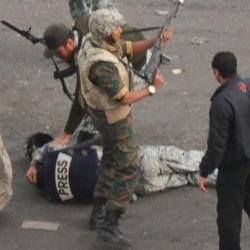
Journalists are informing that Egyptian police, Mubarak's secret police and supporters are attacking them, arresting them, confiscating their equipment and even destroying it. Why do they do that? Well, the answer is very simple. Mubarak's government wants to avoid that journalists tell the truth about the situation in which his country is right now. 

Journalist on the floor being stopped by the army
Media crew from various countries have suffered from the attacks. At first it seemed that just Arabic language news channels (al-Jazeera and al-Arabiya) were the target of pro-government protesters, but in the last few days press crew from Britain, the US, Spain, Greece and France have also been injured. 

As Mubarak cannot control the protests and Egyptians, he at least tries to control the media. His first movement was to cut Internet access in the country so that the population could not inform others via Emails, Facebook or Twitter. His tactic worked for some days but operators quickly found a way to overcome Mubarak's cuts. When the Internet was restablished, the next step was the media, broadcast and print media. 

At this moment nobody with a notepad or camera in hand is safe in Egypt. The government is determined to hide the truth and will do anything to achieve that. However, Mubarak and his supporters are not being successful. This time he will not end up being victorious by playing with the truth. Fortunately, the world seems not to accept anymore war spin and propaganda. 

Below you can watch a video showing the experiences of two journalists attacked in Cairo. 

Saturday, 22 January 2011

War Spin

The first lesson of the module "Contemporary Theory and Issues in Public Relations" was about spinning during war times. 
Terry Lloyd, journalist who reported from Iraq

In times of war, governments want to have public opinion in favour. This is why it is important to show a positive image of their actions. Spin during war times has long been used but the most recent and clear example is the Iraq War. 


During the Iraqi War thousands of journalists travelled to Iraq as embedded journalists to report from the first war line. However, the allies tried to manipulate the journalists from the very beginning by providing them with the information they wanted, by not answering some questions which could put them in a bad position, by keeping hundreds of journalists away from the front line and just receiving information from TV channels, etc. 
José Couso, cameraman who died during the Iraq War

But this is simply propaganda. The sole purpose of this was to keep a good image of the allies throughout the war. They used the media, one of the most trusted channels of information by the public, to place themselves as the “savers” and demonise the Iraqi Government.

The use of PR during war times leads usually to spin, persuasion and propaganda. As future PR practitioners we should think about the boundaries of our job, if we lie or hide the truth to protect our client and if it is ethical to use other professionals to spread what we want to be believed. 

For more information realted to War Spin visit the following links:
- BBC News: 
http://news.bbc.co.uk/1/hi/programmes/correspondent/3028585.stm
- Time: 
http://www.time.com/time/magazine/article/0,9171,1004965-1,00.html
- Blog of a University of Westminster student:
http://contemporarypr.blogspot.com/2010/01/war-spin-pr-and-propaganda.html

Welcome!

Hello everybody and welcome to my blog "Thoughts on Public Relations". 

In this blog I will be posting thoughts and information about contemporary issues in Public Relations. The blog is part of a module which explores contemporary theories and issues in PR from the MA Public Relations I am currently studying. 

I hope you enjoy your time reading other people's and my thoughts on different issues involving PR. Feel free to comment, suggest any ideas or ask any questions you may have.

Hope to see you blogging here!  
Marina