Showing posts with label Twitter. Show all posts

Wednesday, 2 March 2011

The use of social media for PR purposes

These days everybody is talking about social media and its effect on society. It seems that everything we do now is linked to social media and this is, in a way, true. Social media is affecting our daily life and decisions in a manner that has exceeded all predictions. 

Businesses have also become aware of the importance of social media and have now incorporated it to its communication channels and Public Relations plays an important role as far as the use of social media in a company is concerned. 

The use of social media by corporates started mainly with a marketing purpose in mind but now, they have realised that the use of social media with public relations purposes can benefit the company in an incredible way. 

Public Relations has a huge amount of social media tools at its disposal. These tools can be used to build and promote brand reputation, raise awareness, target a wider audience, interact with them and enable a two-way communication, communicate specific messages to desired stakeholders and receive suggestions from them. These are just some examples of the benefits of social media for a corporate communications use.  

With platforms such as Facebook companies can create fan pages with which they can form a community and interact with it. This way they can inform their audiences more directly as well as listen to their personal opinions. The same happens with Twitter, although it offers the advantage that the message is spread quicker to a wider audience. With YouTube, for instance, the CEO can communicate a message to the company's stakeholders or viral videos can be posted with the purpose of raising awareness; and Linkedin, for example, can help companies to find new employees. 

Letting the message outside and allowing interaction also implies the possibility of receiving criticisms. When this happens, it is essential to answer positively and quickly so that these critics do not get viral and start flooding the company's social media sites. For this reason, it is vital that Public Relations constantly monitor what is been said in social media about the organisations they are working for. 

The following webcast goes through these and oher issues concerning social media and its relation to PR. I hope you enjoy it!


This video is part of an assignment and has an educational purpose. Images have been taken from different sources on the Internet.

Saturday, 5 February 2011

When the Truth must be kept secret

These last days on television, newspapers, radio, blogs, twitter, on the street... we continuously hear the news and information about the uprising in Egypt. Thousands, millions of people are taking the streets in the capital city to protest against the repressive regime of Mubarak, who has been oppressing its inhabitans and has been involved in corrupt activities. They demand his immediate resignation, but Mubarak seems not to listen.

We are able to receive all this information because we live in a global world where anyone can get news 24/7, where correspondents are sent to the focus of news, where journalists work all day and expose themselves to danger so that we can be informed about what is going on in the world. And, sometimes, it is not easy for them to do their job.
Protests at Tahrir Square, Cairo

In the Egypt riots these last ten days we hear how difficult it is to inform about a repressive country in hard times. Despite the fact that we are in the 21st century some governments do not care about international law or press freedom when it is about preserving their image. 

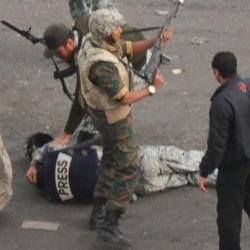
Journalists are informing that Egyptian police, Mubarak's secret police and supporters are attacking them, arresting them, confiscating their equipment and even destroying it. Why do they do that? Well, the answer is very simple. Mubarak's government wants to avoid that journalists tell the truth about the situation in which his country is right now. 

Journalist on the floor being stopped by the army
Media crew from various countries have suffered from the attacks. At first it seemed that just Arabic language news channels (al-Jazeera and al-Arabiya) were the target of pro-government protesters, but in the last few days press crew from Britain, the US, Spain, Greece and France have also been injured. 

As Mubarak cannot control the protests and Egyptians, he at least tries to control the media. His first movement was to cut Internet access in the country so that the population could not inform others via Emails, Facebook or Twitter. His tactic worked for some days but operators quickly found a way to overcome Mubarak's cuts. When the Internet was restablished, the next step was the media, broadcast and print media. 

At this moment nobody with a notepad or camera in hand is safe in Egypt. The government is determined to hide the truth and will do anything to achieve that. However, Mubarak and his supporters are not being successful. This time he will not end up being victorious by playing with the truth. Fortunately, the world seems not to accept anymore war spin and propaganda. 

Below you can watch a video showing the experiences of two journalists attacked in Cairo.