Showing posts with label information. Show all posts

Saturday, 9 April 2011

Google and the cost of free

Back in 1996 Larry Page and Sergey Brin realised the need of creating a service that classified all the information on the Web in a logical way so that it could be searched quickly when needed. This was the start of one of the most used search engine and one of the biggest companies in the world, Google.

Google now forms part of everyone's life, either as a search engine, mail provider, picture and video platform, as a mobile operating system or as any other service form its never ending list. But, do we really know what we are exposed to when we use any of Google's services? 

Sergey Brin and Larry Page
Page and Brin wanted to offer a service that was free for everyone to use. However, they also had to cover costs so finally they decided that the solution was advertising. Nevertheless, they created a different type of advertising, tailored advertising. Depending on one person's search, ads related to that topic will appear on two sides of Google, at the top and on the right hand side. Whenever a user clicks on these ads Google receives money from advertisers and this is how they make their money.

As shown in the BBC series "The Virtual Revolution" by Dr. Aleks Krotoski, Google controls a lot of information about us. As stated before, with every search we do on its search engine, Google knows our interests and problems; by using Google Maps, Google can know where we live, where we go... and that is not everything! Google even scans your emails if you are using its Gmail service so that it can, again, place some ads related to the content of your emails. 

All this arises the question of how far Google is meddling in our personal privacy. If they keep information about our interests and information contained in our mails such as telephone numbers, addresses and names of friends, and this information is leaked and goes public we can be at a high risk if all these data fall into a stranger's hands.

In the episode "The Cost of Free" from The Virtual Revolution, a journalist of the New York Times could put name to a woman just by putting together the information of her search results. In 2006 AOL had released the search results of thousands of users which were just named by a numerical code. The journalist wanted to prove that even though the users were anonymous they could be identified just by its searches.  

We trust Google when we use its services because we believe we do it privately and anonymously, however, the reality seems to be quite different. Despite Google's ethical codes we are still exposed to some risks when we make use of the services they offer. The concept of privacy has changed in the 21st century but we still have to think how far can these companies interfere in our private lives and whether there should be some kind of regulation as fas as the use of private data is concerned. 

I deeply recommend watching the episode "The cost of free" from the BBC series "The Virtual Revolution". It is worth knowing more about how Google works and what it implies for all of us.

Here you find a clip of one of the episodes of "The Virtual Revolution": http://www.youtube.com/watch?v=ECLBQfLwD0s
A short speech of Google's Director of Communications.

Saturday, 5 February 2011

When the Truth must be kept secret

These last days on television, newspapers, radio, blogs, twitter, on the street... we continuously hear the news and information about the uprising in Egypt. Thousands, millions of people are taking the streets in the capital city to protest against the repressive regime of Mubarak, who has been oppressing its inhabitans and has been involved in corrupt activities. They demand his immediate resignation, but Mubarak seems not to listen.

We are able to receive all this information because we live in a global world where anyone can get news 24/7, where correspondents are sent to the focus of news, where journalists work all day and expose themselves to danger so that we can be informed about what is going on in the world. And, sometimes, it is not easy for them to do their job.
Protests at Tahrir Square, Cairo

In the Egypt riots these last ten days we hear how difficult it is to inform about a repressive country in hard times. Despite the fact that we are in the 21st century some governments do not care about international law or press freedom when it is about preserving their image. 

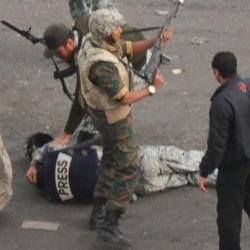
Journalists are informing that Egyptian police, Mubarak's secret police and supporters are attacking them, arresting them, confiscating their equipment and even destroying it. Why do they do that? Well, the answer is very simple. Mubarak's government wants to avoid that journalists tell the truth about the situation in which his country is right now. 

Journalist on the floor being stopped by the army
Media crew from various countries have suffered from the attacks. At first it seemed that just Arabic language news channels (al-Jazeera and al-Arabiya) were the target of pro-government protesters, but in the last few days press crew from Britain, the US, Spain, Greece and France have also been injured. 

As Mubarak cannot control the protests and Egyptians, he at least tries to control the media. His first movement was to cut Internet access in the country so that the population could not inform others via Emails, Facebook or Twitter. His tactic worked for some days but operators quickly found a way to overcome Mubarak's cuts. When the Internet was restablished, the next step was the media, broadcast and print media. 

At this moment nobody with a notepad or camera in hand is safe in Egypt. The government is determined to hide the truth and will do anything to achieve that. However, Mubarak and his supporters are not being successful. This time he will not end up being victorious by playing with the truth. Fortunately, the world seems not to accept anymore war spin and propaganda. 

Below you can watch a video showing the experiences of two journalists attacked in Cairo. 

Saturday, 22 January 2011

War Spin

The first lesson of the module "Contemporary Theory and Issues in Public Relations" was about spinning during war times. 
Terry Lloyd, journalist who reported from Iraq

In times of war, governments want to have public opinion in favour. This is why it is important to show a positive image of their actions. Spin during war times has long been used but the most recent and clear example is the Iraq War. 


During the Iraqi War thousands of journalists travelled to Iraq as embedded journalists to report from the first war line. However, the allies tried to manipulate the journalists from the very beginning by providing them with the information they wanted, by not answering some questions which could put them in a bad position, by keeping hundreds of journalists away from the front line and just receiving information from TV channels, etc. 
José Couso, cameraman who died during the Iraq War

But this is simply propaganda. The sole purpose of this was to keep a good image of the allies throughout the war. They used the media, one of the most trusted channels of information by the public, to place themselves as the “savers” and demonise the Iraqi Government.

The use of PR during war times leads usually to spin, persuasion and propaganda. As future PR practitioners we should think about the boundaries of our job, if we lie or hide the truth to protect our client and if it is ethical to use other professionals to spread what we want to be believed. 

For more information realted to War Spin visit the following links:
- BBC News: 
http://news.bbc.co.uk/1/hi/programmes/correspondent/3028585.stm
- Time: 
http://www.time.com/time/magazine/article/0,9171,1004965-1,00.html
- Blog of a University of Westminster student:
http://contemporarypr.blogspot.com/2010/01/war-spin-pr-and-propaganda.html